
FIRE STUDY BOOK TEXT
Text of the artist’s book FIRE STUDY, by Amy Borezo
—-
THE SPACE THUS PRODUCED
The teenager walks out of the house, crosses a state road, and continues on for two blocks. They veer south behind a large building where a set of train tracks runs along a small river.
The large building was first a shoe factory, then a tapioca factory, then a furniture factory, then a furniture showroom called ‘The Bedroom Factory’, and now is a collection of rented spaces with a large portion of the building used for the manufacture of plastic trash bags.
After walking for ten minutes, the teenager turns and emerges out of the corridor of train tracks into a cluster of empty brick buildings set directly on the banks of the river.
They remember these buildings as ones that burned about ten years ago. Their father brought them into town to see the conflagration. Some did not burn completely and ten years later still have tarps on their roofs which cover the holes created by fire.
The teenager walks toward one of the buildings that avoided the blaze. At the back of the multi-story brick structure is an entrance with a broken lock.
If the eighteen year old walked ten minutes west or north instead of east, they would come across forest, streams, and a beaver dam instead of the old brick factory buildings.
The teenager wants to move away from this place. The town itself is not full of human activity, or at least activity they feel connected to.
Walking along the train tracks is an activity. Picking their way across the old slats of the unused train trestle bridge is an activity. Going into abandoned buildings is an activity.
They work at the local food market, hang out with friends, and drive on empty roads. Many things require a car which they borrow from their parents. They take up cycling as another way to move on a path away from home.
On the weekend of the teenager’s high school graduation another one of the brick buildings burns.
People refer to it as the Cereal Factory Fire. At one time the building housed the New Home Sewing Machine Co. Three younger kids went into the building and accidentally started a seven alarm fire that would bring down the large building with fire crews of 20 towns responding.
As the fire progresses, the teenager goes up onto the roof of the Bedroom Factory to watch the other building go up in flames.
From the roof they also look down at the river and the old train trestle bridge they walk across on occasion. Its unused dry-rotted slats caught fire one day out of nowhere during a hot dry spell.
Fewer and fewer people walk across the bridge now as the path is too difficult.
THE SPACE THUS PRODUCED ALSO SERVES AS A TOOL OF THOUGHT AND OF ACTION; THAT IN ADDITION TO BEING A MEANS OF PRODUCTION IT IS ALSO A MEANS OF CONTROL, AND HENCE OF DOMINATION, OF POWER
FIRE IS A VIOLENT FORM OF DECOMPOSITION
—-
NATURE APPEARS AS THE VAST TERRITORY OF BIRTHS
I am pregnant and surrounded by woods.
They tell me to walk a lot when I am pregnant so I walk outside almost every day along the dirt road outside of our rented house or on nearby trails.
Some of the forests here are privately owned and some are owned by the state. Tracks criss-cross the woods. Walking paths, cart trails, power lines, and dirt roads. Over seventy percent of land in this rural county is forest.
The woods are dense, shading roads and paths at every hour. The line of trees is broken only by the occasional yellow diamond notice of conservation land nailed to a trunk here and there.
With the unchanging density, I often lose track of time and distance on my walk.
I am due in late April and my baby shower is happening during mud season when the dirt roads are sometimes impassable by car and walking becomes difficult. The mud forms waves that grab at car tires and boots.
After mud season is one of two fire seasons.
Here in the western portion of Massachusetts rain fall is increasing to deluge-like rain events and more and more days feel damp and humid. But there is a fire season in the spring and late fall, after and before the snow, with dead leaves on trees, dry stretches of weather, and high winds.
Three months after our baby is born, we move to a neighboring town of 7500.
It is run down and at some distance from areas with more jobs, which makes it affordable for us to buy a small house on a tiny lot.
The center of town is an intersection of North, South, East, and West Main Streets. The first night we sleep in our house off of West Main Street, I can hear cars passing. I like this sound after living surrounded only by trees.
I walk into town often, putting the baby in a used hot pink jogging stroller. The emptiness of the storefronts in the center stands out but doesn’t really bother me. I think of all of the things that can go inside of them, their potential for activity.
We heat our house with wood like many do here. It is cheaper than oil and we can have heat if the power goes out in a winter storm.
Years pass. I consider some of the fires that have occurred in town:
the house fire where we went for a children’s birthday party; a chimney fire that spread into the walls of a friend’s house; the house fire on North Main Street where the multi-generational family lives; the house fire on West Main Street where someone fell asleep with a lit cigarette; the house next door to it; the house fire near the bank.
The sagging emptiness of buildings here is like an invitation. Once a structure burns, it doesn’t get rebuilt and people move away. The county’s population dwindles as lack of investment multiplies. Young people leave to find jobs in other places.
THESE SPACES ARE PRODUCED. THE ‘RAW MATERIAL’ FROM WHICH THEY ARE PRODUCED IS NATURE.
FIRES BEGIN AS POINT SOURCES. THE SOURCES MAY BE ISOLATED OR THEY MAY OCCUR IN MULTIPLES
—-
POLITICAL PRODUCTS AND STRATEGIC SPACES
I notice the high voltage powerlines more when I walk through the woods. They buzz and crackle overhead. We get the message that nature should be full and empty – full of nature and empty of humans and built structures. And the towns we live in apart from nature should be full of human activity.
These powerlines are part of a network that run through a rare sand plain habitat just west of here. Situated next to the region’s largest river, the dry sandy soil is the result of glacial retreat and deposit. On the sand plain, certain species like the pitch pine tree and shrub oak can thrive under the right conditions.
These species want to burn. They are adapted to fire. Pitch pine cones open with fire and release seeds that root best in the disturbed mineral soil after a fire. The pitch running through the trunk of the tree is highly flammable. It leaks out of the tree freely whenever the bark is marred, an anti-bacterial salve for the wound.
The shrub oak in turn is a low growing species that rebounds quickly after fire, growing more robust. The rare Buck Moth feeds on the shrub oak and it in turn acts as food for other animals, creating a complex biodiverse web that would be threatened with the disappearance of this habitat.
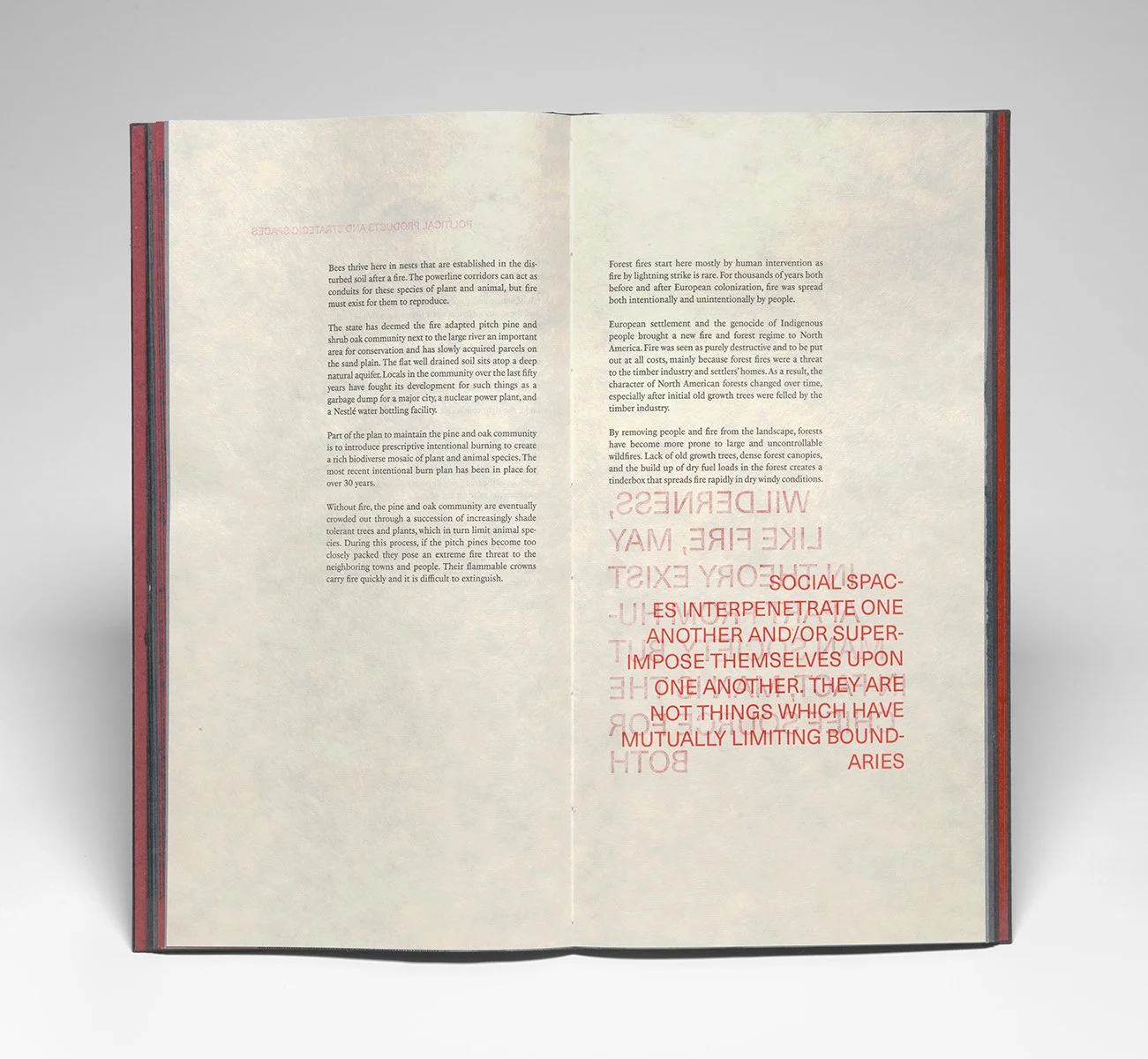
Bees thrive here in nests that are established in the disturbed soil after a fire. The powerline corridors can act as conduits for these species of plant and animal, but fire must exist for them to reproduce.
The state has deemed the fire adapted pitch pine and shrub oak community next to the large river an important area for conservation and has slowly acquired parcels on the sand plain. The flat well drained soil sits atop a deep natural aquifer. Locals in the community over the last fifty years have fought its development for such things as a garbage dump for a major city, a nuclear power plant, and a Nestle water bottling facility.
Part of the plan to maintain the pine and oak community is to introduce prescriptive intentional burning to create a rich biodiverse mosaic of plant and animal species. The most recent intentional burn plan has been in place for over 30 years.
Without fire, the pine and oak community are eventually crowded out through a succession of increasingly shade tolerant trees and plants, which in turn limit animal species. During this process, if the pitch pines become too closely packed they pose an extreme fire threat to the neighboring towns and people as their flammable crowns carry fire quickly and it is difficult to extinguish.
Forest fires start here mostly by human intervention as fire by lightning strike is rare. For thousands of years both before and after European colonization, fire was spread both intentionally and unintentionally by people. Indigenous people used intentional burning to create forests that were less dense and prone to uncontrolled wildfire.
European settlement and the genocide of Indigenous people brought a new fire and forest regime to North America. Fire was seen as purely destructive and to be put out at all costs, mainly because forest fires were a threat to the timber industry and settlers’ homes. As a result, the character of North American forests changed over time, especially after initial old growth trees were felled by the timber industry.
By removing people and intentional fire from the landscape, forests have become more prone to large and uncontrollable wildfires. Lack of old growth trees, dense forest canopies, and the build up of dry fuel loads in the forest creates a tinderbox that spreads fire rapidly in dry windy conditions. Changing climate also contributes to drier and hotter weather patterns.
SOCIAL SPACES INTERPENETRATE ONE ANOTHER AND/OR SUPERIMPOSE THEMSELVES UPON ONE ANOTHER. THEY ARE NOT THINGS WHICH HAVE MUTUALLY LIMITING BOUNDARIES
WILDERNESS, LIKE FIRE, MAY IN THEORY EXIST APART FROM HUMAN SOCIETY, BUT IN FACT, MAN IS THE CHIEF SOURCE FOR BOTH
—-
EPILOGUE
The teenager moves away to a city. The city that takes its drinking water from the reservoir where they grew up.
The next summer they come home. The large brick debris pile from the Cereal Factory fire is still there on the banks of the small river. It is covered with white plastic sheeting. A fence surrounds it warning people to stay away.
That summer was the best they’ve experienced for a long time. They look at their birth certificate when applying for a passport. It surprises them to remember they were born in the next smaller town over, population 900, at the rented house in the middle of the woods.
They find a secret swimming spot in the forest with big rocks to sit on, under the power lines.
They meet two women there, a couple, who have been coming to the swimming place for years.
I ask if they need to use our car to get around for the summer. Mostly they decline and instead get rides from friends or use their bicycle. This year they have found the bus travels from one end of the county to another.
It’s been a bad fire season. Another house in town burns. Fire crews are on high alert for brush fires. There is a smoky haze that lingers for weeks from wildfires thousands of miles away.
I am standing on a trail in the sand plain. To my left are the large high voltage power lines. A state land manager tells me that the power company has recently replaced all of the pilings that hold up the lines with metal instead of wood as their location next to the plains would make them more susceptible to fire. The ground beneath the power lines is remarkably clear and not overgrown, a combination of mowing, debris removal, and possibly herbicide usage.
She explains that a factory of biodiversity is being created here—plants and animals that can then travel to other parts of the state through corridors like those created by the power company.
She explains that a new species of bee was discovered here and that bees like to nest in the disturbed soil after a fire.
HOW MANY MAPS MIGHT BE NEEDED TO DEAL EXHAUSTIVELY WITH A GIVEN SPACE, TO CODE AND DECODE ALL ITS MEANINGS? WHAT WE ARE MOST LIKELY CONFRONTED WITH IS A SORT OF INSTANT INFINITY
FIRE CAN BE TRANSFORMED BUT NOT ERADICATED
—-